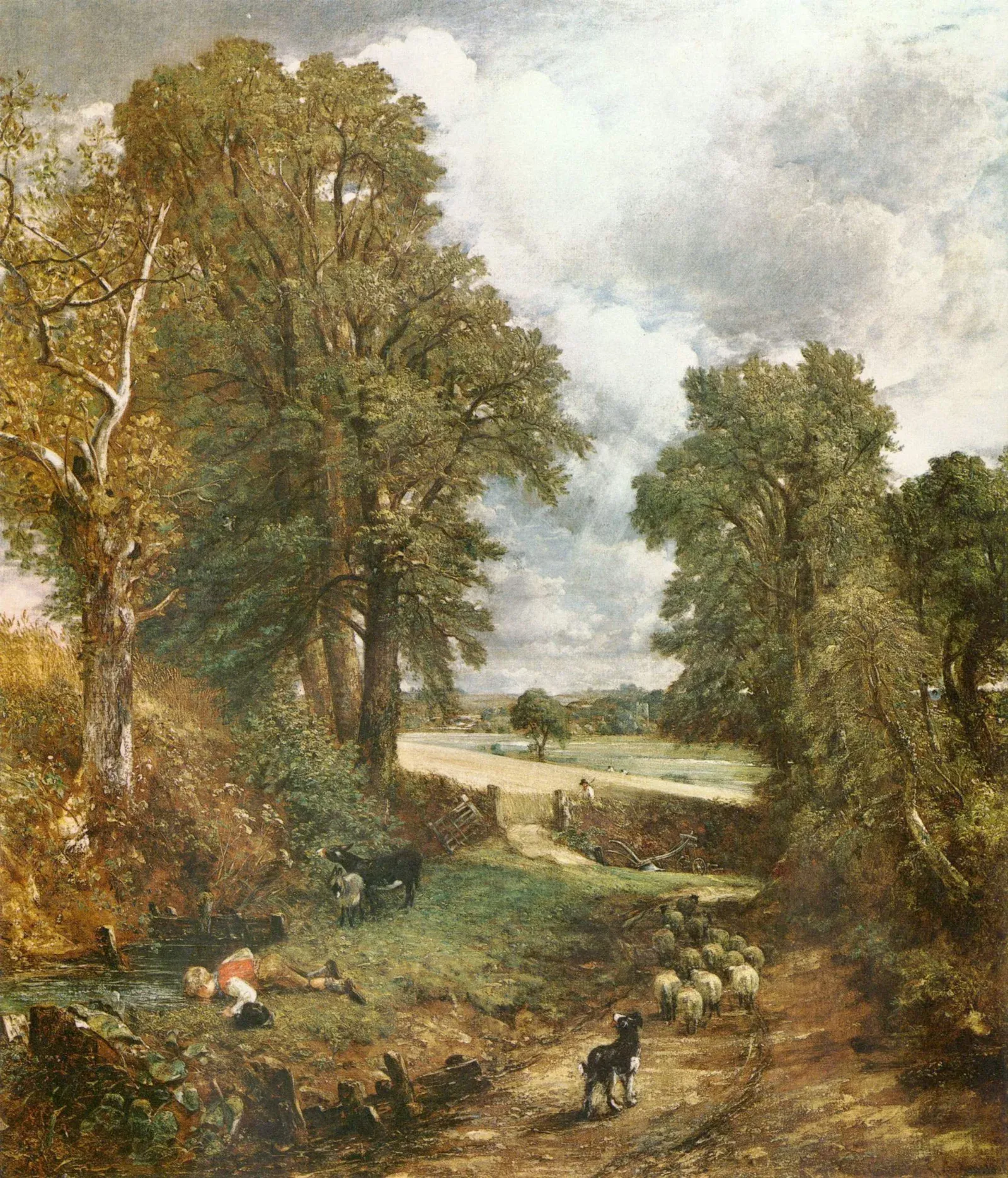

Constable might be my favourite artist ever.
There is something about his paintings that makes me nostalgic for a time I did not live in. Which is ridiculous, really. I know the English countryside of the early 1800s was not some perfect golden world. Life was hard. Work was physical. Medicine was limited. Most people probably did not spend their days wandering around admiring clouds and trees.
But the romantic side of me still feels it.
That is the strange pull of Constable. His paintings make the past look like somewhere you could almost walk into.
What is in the painting
Constable painted The Cornfield in 1826. It shows a boy drinking from a pool beside a country lane, with trees, fields, sheep, a church tower and one of those huge Constable skies above everything. Nothing dramatic is happening. No battle. No myth. No obvious tragedy.
And yet I find it very moving.
Partly, it is the light. Partly, it is the trees. Partly, it is the feeling of a warm day in the countryside where the world seems to have slowed down. The painting feels ordinary, but in a way that makes ordinary life seem precious.
The painting was not an instant success, either. It did not sell when Constable first showed it in 1826. After he died in 1837, a group of admirers, the poet William Wordsworth among them, clubbed together, bought it and gave it to the National Gallery. It became the first Constable in the national collection.
Even Constable was painting a memory
Here is a detail that fits the feeling perfectly. The lane is real. It is Fen Lane, the path Constable walked to school as a boy, from his village of East Bergholt to Dedham. But according to the National Gallery, he invented much of the distant view in his studio, including the church tower and the village.
So even Constable was painting a memory, partly real and partly made up. No wonder it feels like somewhere you remember without ever having been there.
Turner, Constable and the film
I went to the cinema to see Turner & Constable, the Exhibition on Screen film made around Tate Britain’s big Turner and Constable exhibition. I would recommend it to anyone with even a passing interest in either artist. Seeing them placed beside each other made the difference between them feel clearer to me. Turner often seems to paint light as drama. Constable paints light as home.
I would have loved to see the exhibition itself. From what I saw in the film, it must have been amazing. I did not go, much to my regret, and that is one of the downsides of living abroad. You can still love British art from Germany, of course, but sometimes the thing you want to see is sitting in London for a few months and you simply do not get there.
The distance in the painting
Maybe that adds something to the feeling I get from Constable. There is already distance in the paintings: distance from childhood, from England, from a countryside that may never have existed quite the way we imagine it. Looking at him from abroad adds another kind of distance.
That is probably why Constable stays with me. His paintings are not just pictures of fields and rivers. They feel like memories, even when they are not my memories.
I know I am probably responding to an idealised version of the past. But maybe that is part of the point. Constable does not make me want to live in 1826. Not really.
He makes me miss the feeling of belonging somewhere simple, green and full of weather.
And that is a very powerful thing for a painting to do.
Where to see The Cornfield
The Cornfield hangs at the National Gallery in London, and entry to the main collection is free. At the time of writing the gallery lists it in Room 40, the same room as Turner's The Fighting Temeraire, which seems fitting. Rooms do change, so check before you go.
Image credit: John Constable, The Cornfield, 1826, The National Gallery, London. Public domain image via Wikimedia Commons. Source: Wikimedia Commons (The Yorck Project scan). Public domain. The painting is in the public domain, and Wikimedia Commons marks this faithful photographic reproduction of a two-dimensional work as public domain (PD-Art).
More about John Constable on the artists page.