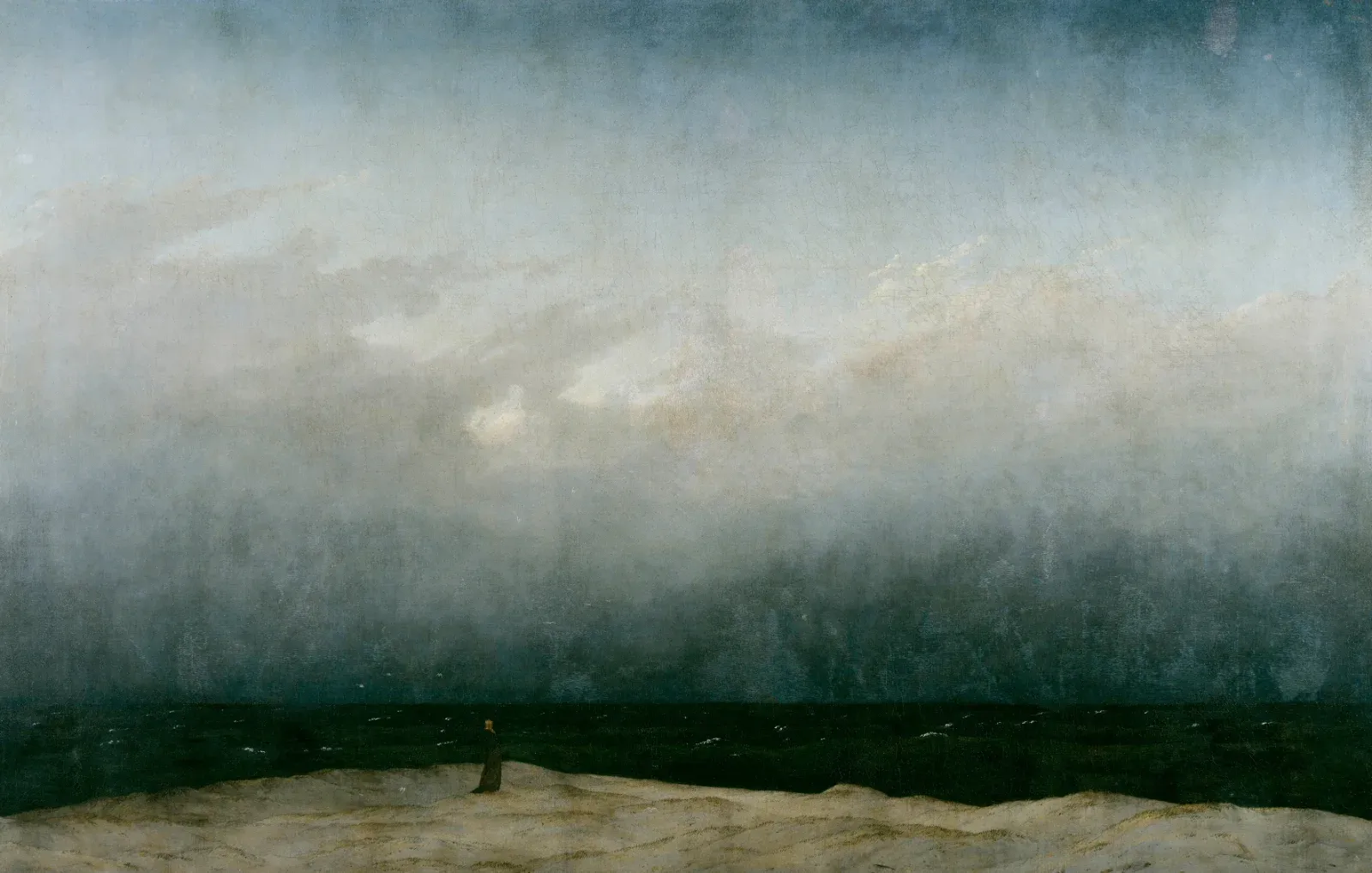

The Monk by the Sea does not capture me quite as much as Wanderer above the Sea of Fog. But it is still a great painting, and in some ways a braver one.
What the painting shows
Caspar David Friedrich painted it between 1808 and 1810. At the bottom there is a pale strip of sand. On it stands a tiny figure in a dark robe, a monk, with his back to us. In front of him is a dark, heavy sea. Above him is sky. Lots and lots of sky.
That is almost all there is. No boats, no birds you can easily pick out, no path, no house, no other people. Friedrich actually painted a couple of small ships on the horizon at first, and later removed them. He wanted the emptiness.
Everything seems a bit insignificant
Looking at it, everything seems a bit insignificant. The monk. Me. Whatever I happen to be worrying about that day.
In Wanderer above the Sea of Fog, the man stands high above the world, and you feel that it is all out there waiting for him. In The Monk by the Sea, it feels the other way round. The world is not waiting for anyone. It is just there, huge and indifferent, and the man is a small dark mark at the edge of it.
I feel powerless when I see it. Not frightened, exactly. More like I have suddenly been reminded of the real scale of things, and it is not in my favour.
Why that is still worth feeling
I think that is what Friedrich wanted. People in his time talked about the sublime: the overwhelming feeling you get in front of something so vast that it makes you aware of your own smallness. Storms, mountains, the sea at night. This painting is about as pure a version of that feeling as I know.
It is a strange thing to want from a painting. But there is something honest about it. Most of the time we live as if we are the centre of everything. The Monk by the Sea quietly says that we are not, and somehow that is a relief as well as a shock.
I would still rather stand with the wanderer, up on his rock, looking out at everything still to explore. But every now and then, it does me good to stand with the monk for a while too.
Where to see The Monk by the Sea
The Monk by the Sea hangs in the Alte Nationalgalerie on Berlin's Museum Island, next to its partner painting, The Abbey in the Oakwood. Seeing the two side by side is worth the trip on its own.
Did you know?
- Friedrich first painted two small sailing ships on the horizon, then painted them out. Without them, there is nothing at all to rest your eyes on. Source: Wikipedia, citing Norbert Wolf
- When it was shown in Berlin in 1810, the writer Heinrich von Kleist said that looking at it was as if your eyelids had been cut away, because the painting has no foreground except the frame. Source: Wikipedia
- Friedrich showed it together with The Abbey in the Oakwood, a dark winter scene with a ruined church and a funeral. The Prussian royal family bought both paintings after the exhibition. Source: Wikipedia
- Both paintings had faded and darkened badly over 200 years. Restorers in Berlin worked on them from 2013 to 2016, removing old overpainting and discoloured varnish. Source: Staatliche Museen zu Berlin
If you want to go deeper
- Friedrich (Basic Art) (affiliate link) A compact introduction to Friedrich's life and work from Taschen's Basic Art series, which I'm a big fan of.
These are affiliate links to TASCHEN. If you buy through them, I earn a small commission at no extra cost to you. I only recommend books I like.
Image credit: Caspar David Friedrich, The Monk by the Sea, 1808 to 1810, Alte Nationalgalerie, Berlin. Public domain image via Wikimedia Commons. Source: Wikimedia Commons (Google Arts & Culture scan). Public domain. The painting is in the public domain, and Wikimedia Commons marks this faithful photographic reproduction of a two-dimensional work as public domain (PD-Art).
More about Caspar David Friedrich on the artists page.