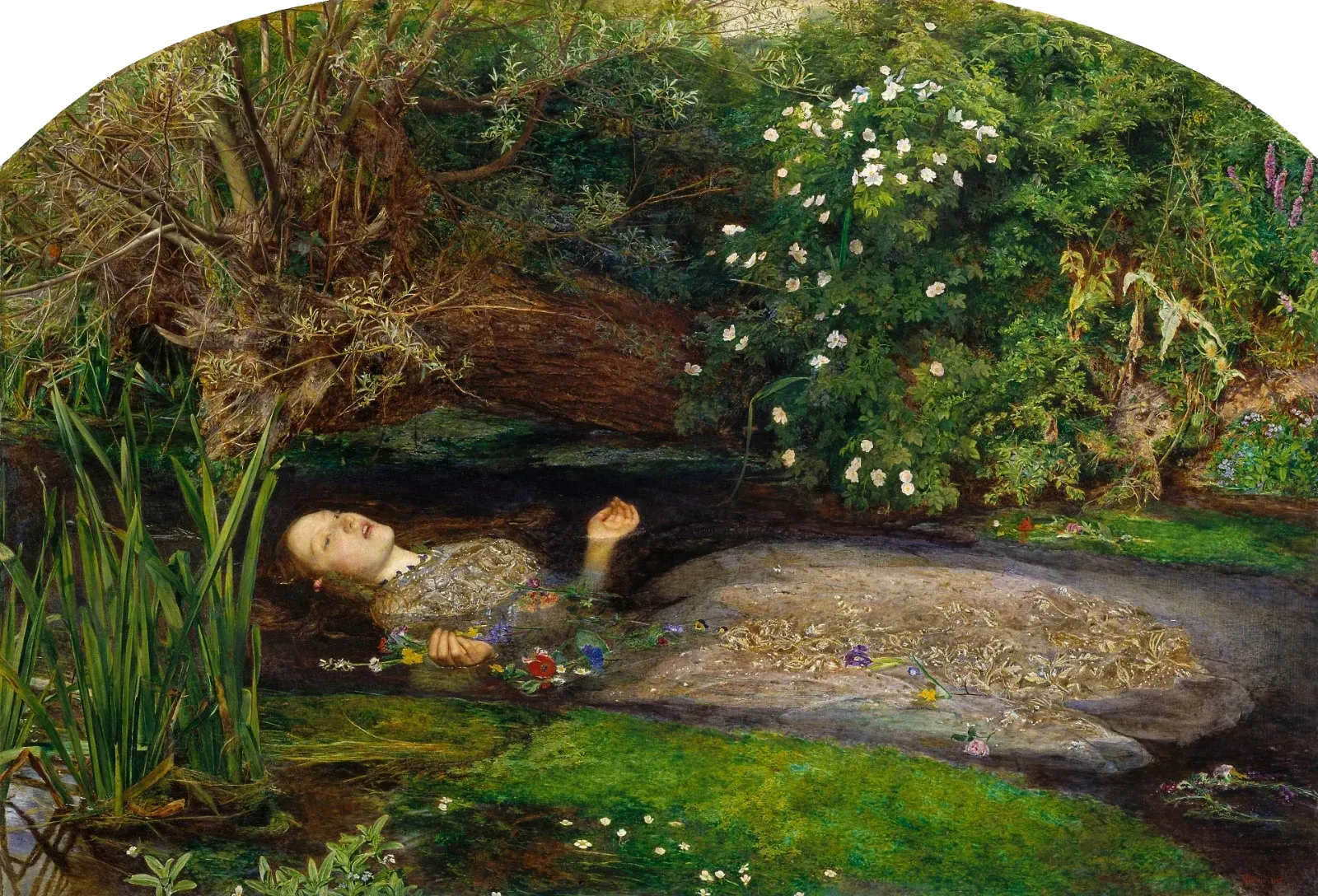

The first thing I thought when I saw Ophelia was: I hope she is going to be OK.
Which is strange, because she is lying in a river, surrounded by flowers, with her dress spreading out around her like she has already become part of the water. Even if you do not know the story, and I didn’t properly know it at first, you get the feeling this probably does not end well.
That is what makes the painting so uncomfortable.
What is happening in the painting
John Everett Millais painted Ophelia between 1851 and 1852. It shows Ophelia from Shakespeare’s Hamlet, after grief and shock have broken her. In the play, she falls into a brook and drowns. Millais gives us the moment in between: she is floating, singing, half-present, half-lost.
Shakespeare never shows her death on stage. Queen Gertrude describes it afterwards. Ophelia’s clothes spread out and hold her up for a while, and she sings snatches of old songs as if she does not understand the danger. Then the water soaks into her dress and pulls her down. Millais paints the “for a while”.
I find that much sadder than a more obvious death scene. There is no dramatic struggle. No wild gesture. No horror on her face. She looks young, tired, and strangely calm, as if the water might carry her somewhere kinder.
Why it is so beautiful, and why that matters
The beauty of the picture almost makes it worse. The flowers are incredibly detailed. The greens are rich. Her dress glows against the dark water. You can look at it first as a beautiful image, then slowly realise what you are actually looking at.
The flowers are not just decoration, either. Victorian viewers knew a whole language of flowers, and Millais used it. The red poppy stands for sleep and death. The violets around her neck can mean faithfulness, or dying young. The daisies suggest innocence. So the prettiest part of the painting is quietly telling you how the story ends.
That tension is probably why people still return to it. Ophelia is not just “a sad painting.” It is a painting about how sadness can be made beautiful, and why that should make us slightly uneasy.
The real effort behind that calm
What I did not know at first is how much hard work sits behind the stillness. Millais painted the riverbank outdoors, beside the Hogsmill River in Surrey, over several months in 1851. Then he painted Ophelia herself back in his London studio.
His model, Elizabeth Siddal, lay in a bath full of water for hours at a time so he could get the floating dress right. Lamps under the bath kept the water warm, until one day they went out and she caught a bad cold. Her father made Millais pay the doctor’s bills.
Knowing that adds another layer for me. That calm face cost a real young woman a lot of discomfort.
Would I want it at home?
I don’t think I would want it above my sofa. But I would absolutely stand in front of it for a long time.
Not because I enjoy the tragedy, exactly. More because it feels like the painting is asking a question I cannot quite answer:
Why does something so painful look so beautiful?
Where to see Ophelia
Ophelia belongs to Tate and hangs at Tate Britain in London, where the collection rooms are free to visit. Tate lists it as on display at the time of writing, but famous paintings do travel to other exhibitions, so I would check before making a special trip.
Image credit: John Everett Millais, Ophelia, 1851 to 1852, Tate. Public domain image via Wikimedia Commons. Source: Wikimedia Commons (Google Arts & Culture scan). Public domain. The painting is in the public domain, and Wikimedia Commons marks this faithful photographic reproduction of a two-dimensional work as public domain (PD-Art).
More about John Everett Millais on the artists page.