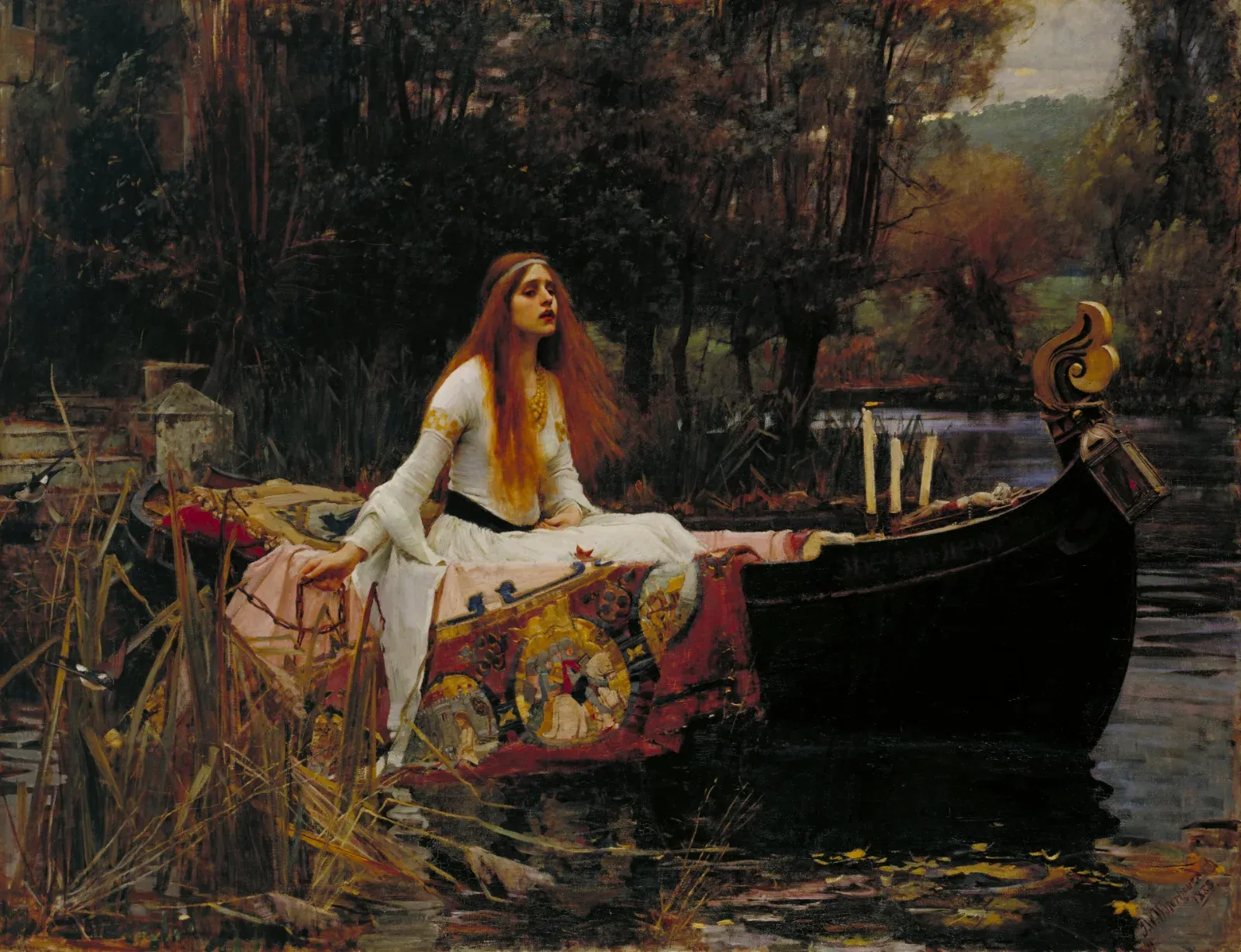

The Lady of Shalott is a timeless piece.
Waterhouse painted it in 1888, but it does not feel stuck in the 1880s. She could almost be from the hippie years of the 1960s or 70s, with her long hair, her loose white dress and her little boat drifting off down a river. Or from countless other time periods. That is part of why it works. She does not belong to one moment. She belongs to anyone who has ever wanted something badly enough to risk everything for it.
What is happening in the painting
The painting comes from Tennyson’s poem The Lady of Shalott. She lives under a curse in a tower on an island near Camelot. She is not allowed to look directly at the world, so she watches it in a mirror and weaves what she sees into a tapestry.
Then Sir Lancelot rides past. She turns from the mirror to look at him, the mirror cracks, and the curse falls on her. She leaves the tower, finds a boat, writes her name on it and floats down the river towards Camelot, singing. By the time she arrives, she is dead.
Waterhouse paints the moment she sets off. She is sitting in the boat on her own tapestry, holding the chain that ties it to the bank, about to let go.
The look on her face
The longing, or maybe the desperation, in her face is obvious. She is looking towards something we cannot see, with her lips slightly open, as if she is already halfway somewhere else.
And I want her to find happiness. I really do.
But I’m not sure she will.
That is the strange feeling this painting leaves me with. I still feel hopeful for her, but with a worry of foreboding in my stomach. She has finally broken out of the tower. She has finally chosen to see the world for herself. Surely that has to count for something?
Everything else is a warning
Then you start to notice the details, and they are not on her side.
There are three candles on the boat, and two of them have already gone out. There is a crucifix at the front. Swallows fly low over the water. Even a dead leaf drifts past. Waterhouse fills the picture with small signs that this journey will not end well, while her face keeps telling you she hopes it will.
That is what makes it so moving for me. The painting knows how the story ends. She does not, or she does not want to.
The colours, of course
The colours and the background are incredibly well painted, of course. The reeds, the water, the dark trees behind her and the soft greens and browns make the whole scene feel cool and still. Against all that, her white dress and pale face almost glow.
It is a beautiful place to be sad. Maybe that is why it stays with me.
I keep coming back to the same small hope. Maybe this time she makes it to Camelot. Maybe this time somebody is waiting for her.
I know she doesn’t. But I hope anyway.
Where to see The Lady of Shalott
Free to visit Amazing art should be available to everyone, and this one is.
The Lady of Shalott belongs to Tate and hangs at Tate Britain in London, and the collection rooms are free to visit. Tate lists it as on display at the time of writing. Popular paintings do travel, so I would check before making a special trip.
Did you know?
- Waterhouse painted the Lady of Shalott three times. This 1888 version shows her setting off. An 1894 painting shows her looking at Lancelot as the curse strikes, and a 1915 painting, I am Half-Sick of Shadows, shows her still at her loom. Source: Tate
- Of the three candles on the boat, two have already gone out. Tate reads them as a sign that her life will end soon. Source: Tate
- Waterhouse came long after the original Pre-Raphaelite Brotherhood, which formed in 1848, the year before he was born. He carried their love of myth, poetry and detail into the 1880s and beyond. Source: Wikipedia
- Sir Henry Tate, the sugar merchant who founded the Tate, gave the painting to the nation in 1894. Source: Wikipedia
If you want to go deeper
- Victorian Rebels. Pre-Raphaelites (Basic Art) (affiliate link) A short, richly illustrated introduction to the Pre-Raphaelites and the painters who followed them, from Taschen's Basic Art series. I'm a big fan of the series.
These are affiliate links to TASCHEN. If you buy through them, I earn a small commission at no extra cost to you. I only recommend books I like.
Image credit: John William Waterhouse, The Lady of Shalott, 1888, Tate. Public domain image via Wikimedia Commons. Source: Wikimedia Commons (Google Arts & Culture scan). Public domain. The painting is in the public domain, and Wikimedia Commons marks this faithful photographic reproduction of a two-dimensional work as public domain (PD-Art).
More about John William Waterhouse on the artists page.