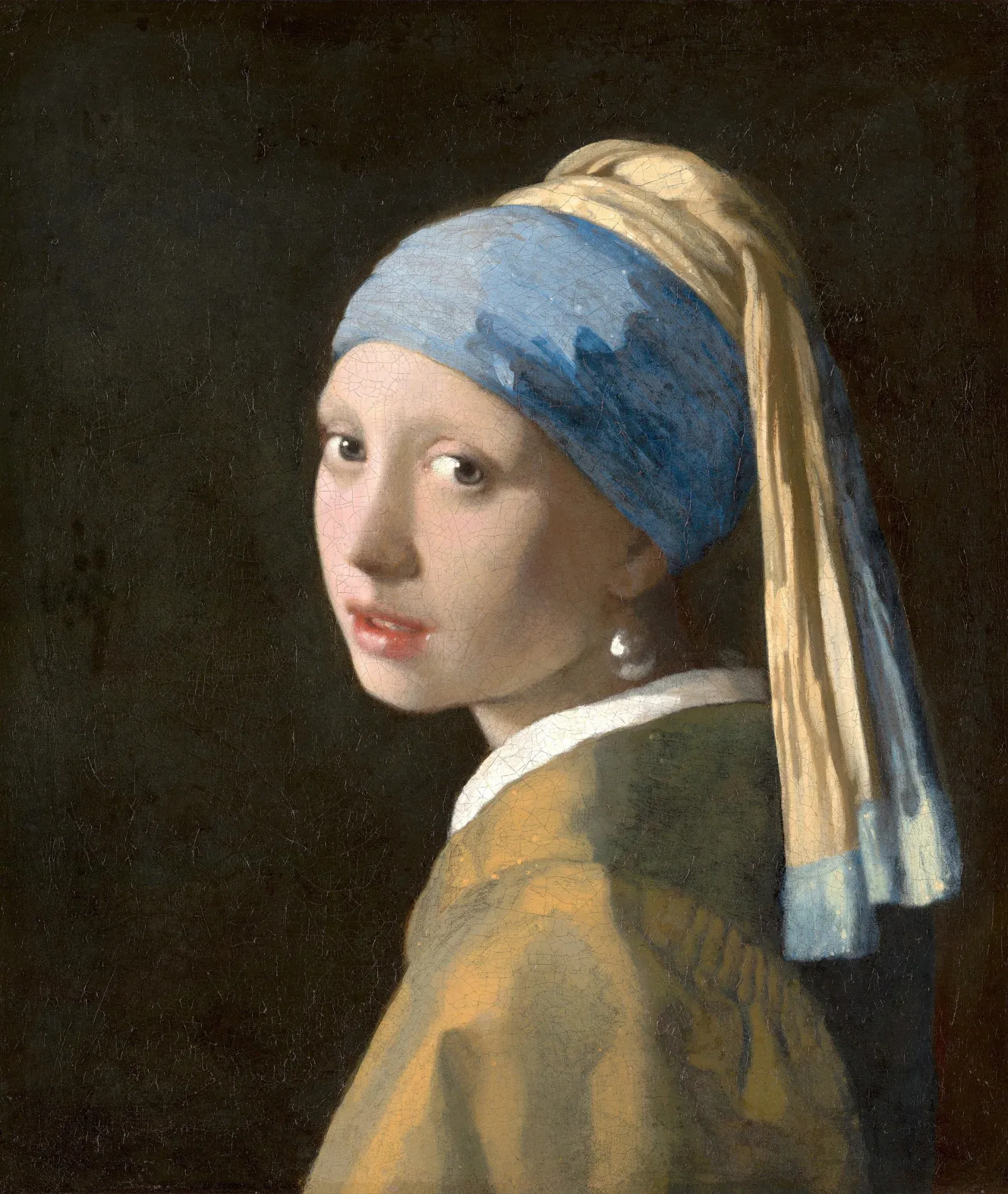

For me, Vermeer is all about the light and the realism. With Girl with a Pearl Earring, it is so fantastic that I sometimes can’t believe it was painted so long ago.
Around 1665. Think about that. No photography, no electric light, no tubes of ready-made paint. And yet her face looks as if she has just turned round to see who came into the room.
So who was she?
The honest answer is that nobody knows.
The Mauritshuis, which owns the painting, explains that it is not a portrait at all. It is a tronie, the Dutch word for a painting of a face or a character type. Painters made tronies to show off their skill with expressions, costumes and light. There was probably a real young woman sitting for Vermeer, but the point was never to record who she was.
People have guessed, of course. One of Vermeer’s daughters. A maid. A neighbour. Whole novels and a film have been built on those guesses. But there are no letters, no notes, no name.
We will never know who she truly was, and I think that is part of the wonder.
Immortalised in her own way
There is something moving about that. Whoever she was, she probably lived an ordinary life in Delft and was forgotten, like almost everyone from her time. And yet millions of people now know her face better than the faces of kings and queens from the same century.
She is immortalised in her own way, I suppose. Not her name, not her story, just a look over the shoulder, a slightly open mouth and a pearl catching the light.
The light does the rest
Look closely and you can see how much Vermeer does with how little. The background is almost completely dark. The light falls from the left, across her face, onto the white collar and that famous pearl. There are barely any hard edges in her face at all. It just glows softly out of the dark.
The realism is not about detail, exactly. It is about how light behaves. The wet shine on her lips. The tiny reflection in her eyes. The way the pearl is little more than a bright spot and a soft grey shadow, and yet you never doubt that it is there.
I don’t think I will ever fully understand how he did it. I am not sure I want to. Some things are better left with a little mystery.
Just like her.
Where to see Girl with a Pearl Earring
Girl with a Pearl Earring hangs in the Mauritshuis in The Hague, a small and lovely museum right by the Dutch parliament buildings. The painting itself is small too, only 44.5 by 39 centimetres, so be ready for that. The Mauritshuis lists it in Room 15 at the time of writing.
Did you know?
- In 1881 a collector called Arnoldus des Tombe bought the painting at an auction in The Hague for just 2.30 guilders. He later left it to the Mauritshuis in his will. Source: Mauritshuis
- The Mauritshuis says the pearl is too large to be real. It may have been glass, or Vermeer may have invented it. There is not even a hook to hang it from. Source: Mauritshuis
- Vermeer painted the famous pearl with little more than two brushstrokes: one bright highlight at the top and a soft reflection of her collar underneath. Source: Mauritshuis
- Girls in the Dutch Republic did not wear turbans. Vermeer dressed her in a blue and yellow one to give the figure an exotic, imaginary feel. Source: Mauritshuis
If you want to go deeper
- Vermeer (Basic Art) (affiliate link) A short, well-illustrated introduction from Taschen's Basic Art series, which I'm a big fan of.
- Vermeer. The Complete Works (affiliate link) Every one of Vermeer's surviving paintings in a large format, with a fold-out, in 258 pages.
These are affiliate links to TASCHEN. If you buy through them, I earn a small commission at no extra cost to you. I only recommend books I like.
Image credit: Johannes Vermeer, Girl with a Pearl Earring, around 1665, Mauritshuis, The Hague. Public domain image via Wikimedia Commons. Source: Wikimedia Commons (Mauritshuis scan). Public domain. The painting is in the public domain, and Wikimedia Commons marks this faithful photographic reproduction of a two-dimensional work as public domain (PD-Art).
More about Johannes Vermeer on the artists page.