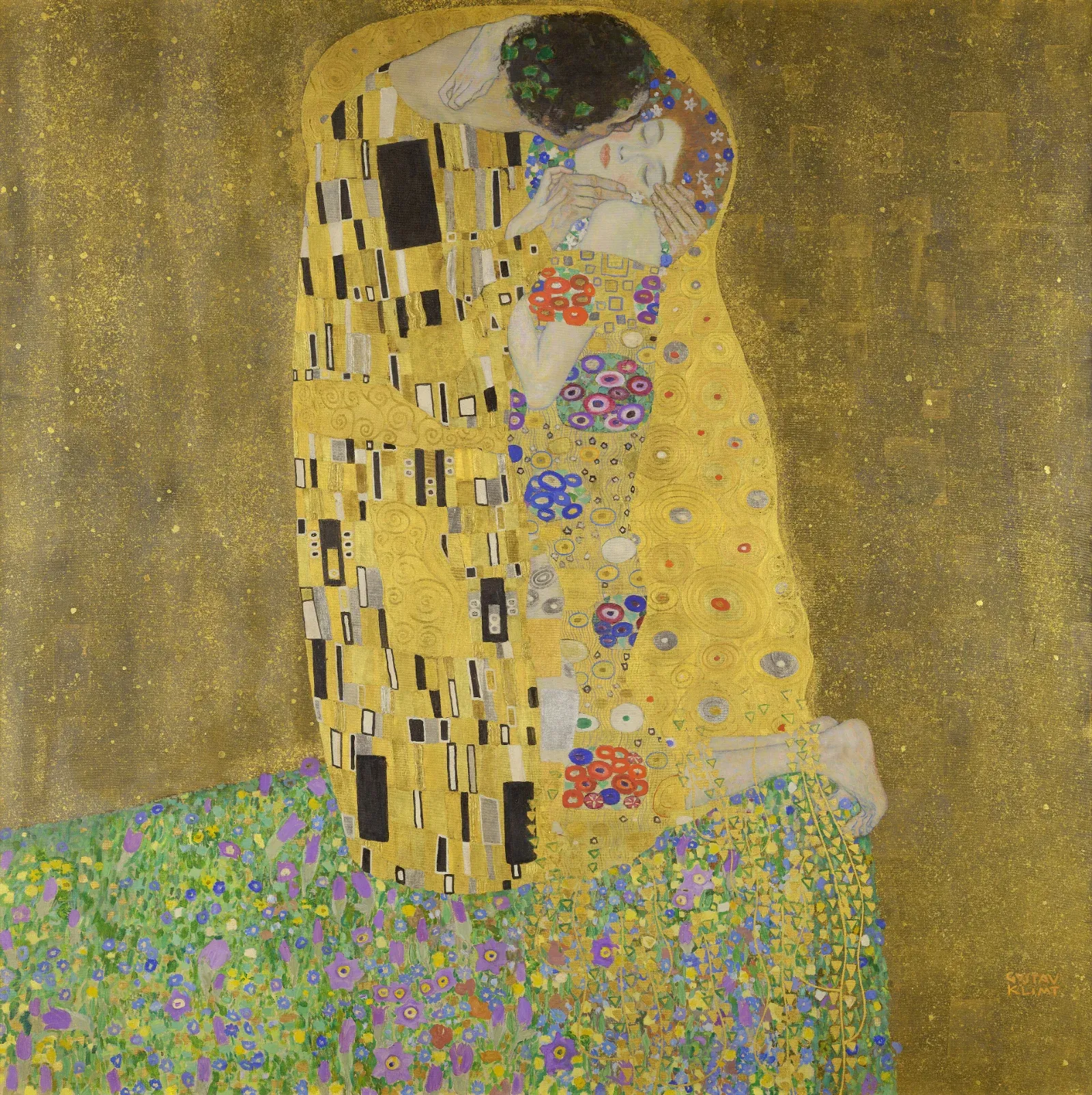

I’m not quite sure why I like The Kiss, to be honest.
It is not much like the other paintings I write about. There is no landscape to walk into, no weather, no light falling across a room. Most of it is pattern: squares, circles, swirls and spirals, all floating on a sea of gold.
And yet I keep coming back to it.
What the painting shows
Gustav Klimt painted The Kiss in Vienna in 1907 and 1908, at the height of what people now call his Golden Period. It shows a man and a woman wrapped together in an enormous golden robe. He bends down to kiss her cheek. She kneels, eyes closed, one hand around his neck, her bare feet curled over the edge of a little meadow full of flowers.
The robe is where all the gold is. His side is full of hard black and white rectangles. Hers is full of soft circles and flowers. The two patterns meet and melt into each other, so it is hard to tell where one person ends and the other begins.
The human touch under all that gold
Maybe that is the answer, or part of it. For all the gold and pattern, the painting has a real human touch, and real passion.
Klimt paints their faces and hands in soft, ordinary skin tones, quite different from the flat shimmer around them. Her fingers press gently into his neck. His hand cups her face. Her eyes are closed. Those small details feel tender and private, and they sit right in the middle of the most decorative painting you could imagine.
So you get two things at once: something almost like an icon, glittering and still, and inside it two people who are simply in love.
The edge of the meadow
There is one detail I find hard to forget. The flower meadow ends right where her feet are. Below them, there is nothing but gold.
Some people read that as danger, as if the lovers are kneeling at the edge of a cliff. I’m not sure Klimt meant anything so dramatic. But it does make the moment feel fragile, as if this kiss is happening right at the edge of something, and the world might drop away at any second.
Maybe that is why it feels so passionate. Love that is completely safe would not need all that gold to protect it.
Why I still can’t fully explain it
I like Klimt’s gold, his sensuality and all that decorative richness that somehow never feels like too much. The Kiss has all of that. But I think what really holds me is simpler.
It is a painting about two people forgetting the rest of the world for a moment. Everyone knows that feeling, or hopes to.
Perhaps that is enough of a reason. Not everything you love needs an explanation.
Where to see The Kiss
The Kiss hangs in the Upper Belvedere palace in Vienna, which owns the largest collection of Klimt's paintings in the world. It draws big crowds, so it is worth booking a timed ticket and going early if you want a few quiet minutes with it.
Did you know?
- The Austrian state bought The Kiss in 1908, the year Klimt first showed it, for 25,000 crowns. According to Wikipedia's sources it was still unfinished when they agreed to buy it. Source: Belvedere via Google Arts & Culture, Wikipedia
- Klimt's father was a gold engraver. Klimt's own love of gold leaf, though, came from a trip to Ravenna in 1903, where he saw the shimmering Byzantine mosaics in the church of San Vitale. Source: Wikipedia
- The canvas is a perfect square, 180 by 180 centimetres, which helps the couple feel like the still centre of a world of pattern. Source: Wikipedia
- Nobody knows for sure who the lovers are. A popular theory says Klimt painted himself and his lifelong companion, the fashion designer Emilie Flöge, but there is no proof. Source: Wikipedia
If you want to go deeper
- Klimt (Basic Art) (affiliate link) 96 pages in Taschen's Basic Art series. A lovely short introduction, and the series is a favourite of mine.
- Gustav Klimt. The Complete Paintings (affiliate link) The big one: more than 600 pages and every painting, gold and all, in a large format.
These are affiliate links to TASCHEN. If you buy through them, I earn a small commission at no extra cost to you. I only recommend books I like.
Image credit: Gustav Klimt, The Kiss, 1907 to 1908, Belvedere, Vienna. Public domain image via Wikimedia Commons. Source: Wikimedia Commons (Google Arts & Culture scan). Public domain. The painting is in the public domain, and Wikimedia Commons marks this faithful photographic reproduction of a two-dimensional work as public domain (PD-Art).
More about Gustav Klimt on the artists page.