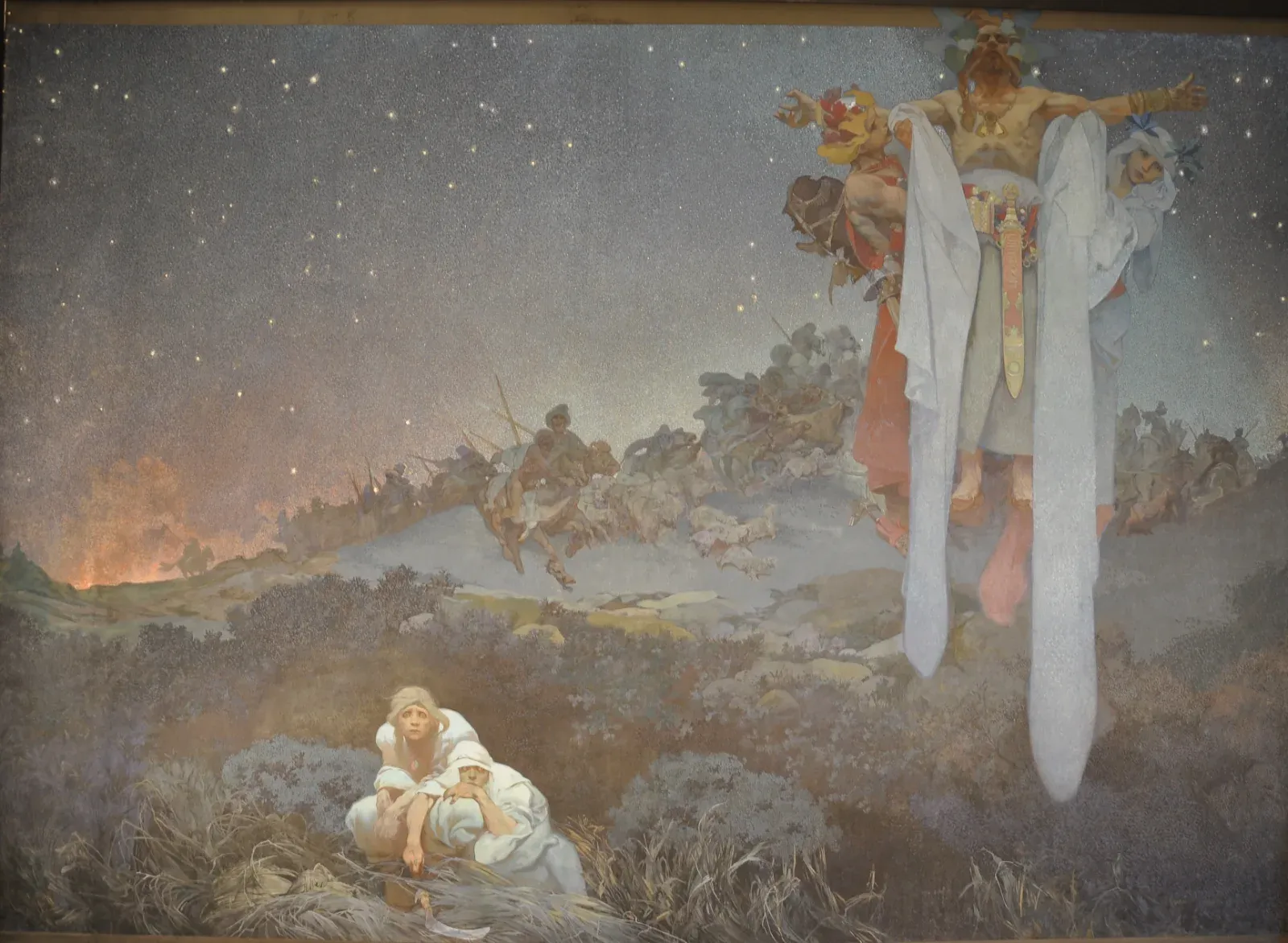

The Slav Epic was incredible.
I saw it in Prague in 2014, and I still feel privileged to have seen such a series of masterworks in one place. It is probably the best art exhibition I have ever seen.
What the Slav Epic is
Most people know Alphonse Mucha for his posters: the elegant Art Nouveau women with flowing hair, framed by flowers and halos, that sold everything from theatre tickets to biscuits in Paris around 1900.
The Slav Epic is something else entirely. It is a cycle of 20 huge canvases telling the story of the Slavic peoples, from their early history to the 20th century. Mucha worked on it for almost two decades, from 1910 into the late 1920s, and some of the canvases are more than six metres high and eight metres wide. Ten paintings deal with Czech history and ten with other Slavic peoples.
The one at the top of this page is the first of the series, The Slavs in Their Original Homeland, from 1912. Two terrified figures crouch in the foreground under a starry sky, hiding while raiders burn their village behind them. It sets the tone for everything that follows.
A history of histories
The best way I can describe it is this: the Slav Epic is a history of histories.
Every single painting has its own story and covers its own part of the past. Battles, councils, religious services, exiles, celebrations. Some are full of crowds, some are strangely quiet. You move from one to the next and travel hundreds of years in a few steps.
What struck me most was how it changes the way you think about the past. Often, when we think through history, we imagine hundreds of years of being vaguely similar, simply because they were so long ago. One century blurs into the next.
The Slav Epic refuses to do that. It makes each time period as important as the others, full of real lives, struggles and happiness. Every individual in those crowds seems to matter. Every era gets its own moment, its own light, its own size on the wall. Standing in front of them, you feel how full the past really was.
A very lucky day
There is a personal side to this memory, too. Our son was about six months old at the time, and we brought him with us.
Amazingly, he slept through the entire two hours we were there. He only woke up as we walked out through the main doors. Talk about lucky!
I sometimes think that is part of why the visit feels so special. We had two whole hours, without interruption, with these enormous paintings. It felt like a gift.
Why it stays with me
Mucha meant the Slav Epic as a message about shared history, peace and humanity. You don’t need to know much about Slavic history to feel that. You just need to stand in front of one of these walls of paint and let it make you feel very small, and then very connected to all those people who lived before you.
It is not easy to get to now. But if you ever have the chance, take it. And if you have a baby with you, I hope yours sleeps as well as ours did.
Where to see The Slav Epic
When I saw the Slav Epic in 2014, it was hanging in the Trade Fair Palace in Prague. Today it is back at the chateau in Moravský Krumlov in South Moravia, and in 2025 Prague agreed to extend the loan there for another five years while the city works on a permanent home. It is a long way from most places, but it is worth the trip.
Brno Daily: Prague extends the Slav Epic's stay in Moravský Krumlov
Did you know?
- The Slav Epic was paid for by an American. Charles Richard Crane, a Chicago businessman, agreed on Christmas Day 1909 to sponsor the project, and supported it for almost twenty years. Source: Mucha Foundation
- The canvases were too big for a normal studio, so Mucha rented rooms at Zbiroh Castle in western Bohemia to paint them. Source: Mucha Foundation
- In 1928 Mucha and Crane gave the whole cycle to the city of Prague, to mark ten years of Czechoslovak independence. Mucha asked for a special building to show it. Almost a century later, it still has no permanent home in the city. Source: Mucha Foundation, Brno Daily
- During the Second World War the paintings were rolled up and hidden to keep them from the Nazis. Mucha himself was interrogated by the Gestapo in 1939 and died that July. Source: Wikipedia
If you want to go deeper
- Mucha (Basic Art) (affiliate link) A compact introduction to Mucha's whole career, from the Paris posters onwards, in Taschen's Basic Art series.
These are affiliate links to TASCHEN. If you buy through them, I earn a small commission at no extra cost to you. I only recommend books I like.
Image credit: Alphonse Mucha, The Slavs in Their Original Homeland (The Slav Epic, no. 1), 1912, City of Prague. Public domain image via Wikimedia Commons. Source: Wikimedia Commons. Public domain. The painting is in the public domain, and Wikimedia Commons marks this faithful photographic reproduction of a two-dimensional work as public domain (PD-Art).
More about Alphonse Mucha on the artists page.